
Hair loss affects millions of people every year. It can happen slowly over time or come on suddenly. It can affect men, women, and even younger adults. And for most people, it is more than just a physical change. It affects confidence, self-image, and quality of life.
But here is the good news. Today, there are advanced treatments that go beyond pills and surgery. Regenerative therapies like PRP therapy, stem cell therapy, and exosome therapy are changing the way hair loss is treated. And right here in the Kansas City area, you can access these treatments at Kansas Regencares.
Before we get into the solutions, let us first understand what causes hair loss in the first place.
What Causes Hair Loss?
Hair loss does not have one single cause. It can result from genetics, hormones, health conditions, lifestyle habits, or a combination of all of these. Understanding the root cause is the first step toward finding the right treatment.
Androgenetic Alopecia (Pattern Baldness)
This is the most common cause of hair loss in both men and women. It is genetic, meaning it runs in families.
In men, it typically starts with a receding hairline or thinning at the top of the head. In women, it usually shows as a widening part or overall thinning, rather than full baldness.
The condition is driven by a hormone called dihydrotestosterone (DHT). DHT shrinks hair follicles over time, causing them to produce thinner and shorter strands until they stop growing altogether.
This is also known as androgenetic alopecia, and it is one of the leading causes of hair loss in men and women worldwide.
Hormonal Hair Loss
Hormones play a major role in hair growth. When hormone levels shift, hair can respond by shedding more than usual.
Common hormonal triggers include:
- Thyroid disorders: Both an overactive and underactive thyroid can disrupt the hair growth cycle, causing thinning and shedding across the scalp.
- Postpartum changes: After pregnancy, estrogen levels drop sharply. This often causes a period of heavy shedding, usually around three to four months after delivery.
- Menopause: As estrogen and progesterone decline, hair follicles become more sensitive to androgens, which can lead to thinning. This is a major reason why hair loss in women over 40 becomes more noticeable.
- Polycystic ovary syndrome (PCOS): This condition raises androgen levels in women, which can cause hair thinning along the top and front of the scalp.
The good news is that hormonal hair loss is often reversible once the underlying cause is addressed.
Stress-Related Hair Loss (Telogen Effluvium)
Telogen effluvium is a type of hair loss triggered by physical or emotional stress. It happens when a large number of hair follicles shift prematurely into the resting phase of the hair growth cycle, causing widespread shedding.
Common triggers include:
- A major illness or surgery
- High fever or infection
- Sudden and significant weight loss
- Emotional trauma or prolonged anxiety
- Nutritional deficiencies
The shedding usually begins two to three months after the triggering event. Many people panic when they see handfuls of hair coming out, not realizing it is connected to something that happened weeks earlier.
In most cases, telogen effluvium resolves on its own once the stressor is removed. But if the stress is ongoing, the hair loss can become chronic. This is also why people often ask: can stress cause permanent hair loss? In most cases, it does not. But repeated cycles of stress-related shedding can damage follicles over time.
Nutritional Deficiency and Hair Loss
What you eat directly affects how your hair grows. Hair follicles are among the most metabolically active cells in the body. They need a steady supply of nutrients to function.
Deficiencies that commonly contribute to hair fall include:
- Iron: Low ferritin levels are one of the most overlooked causes of hair thinning, particularly in women.
- Vitamin D: Research has linked low vitamin D levels to alopecia areata and other forms of hair loss.
- Zinc: Zinc supports the structure of hair proteins. A deficiency can cause the hair shaft to weaken and break.
- Biotin (Vitamin B7): While rare, a true biotin deficiency can cause brittle hair and increased shedding.
- Protein: Hair is made almost entirely of keratin, a protein. Low protein intake over time can lead to significant hair thinning.
Correcting these deficiencies through diet or supplementation can lead to noticeable improvement in hair thickness and growth.
Alopecia Areata Causes
Alopecia areata is an autoimmune condition where the immune system mistakenly attacks hair follicles. This causes patchy hair loss that can appear suddenly and affect the scalp, eyebrows, eyelashes, and other areas of the body.
The exact cause is not fully understood, but genetic factors and environmental triggers are believed to play a role. It can occur at any age and affects both men and women equally.
In some cases, it progresses to alopecia totalis (complete scalp hair loss) or alopecia universalis (loss of all body hair). Regenerative therapies have shown promise in supporting follicle recovery in some alopecia areata patients.
What Causes Hair Loss at a Young Age?
Many people assume hair loss is a condition that only affects older adults. But it can begin much earlier. In fact, some men start noticing a receding hairline in their late teens or early twenties.
Causes of hair loss at a young age include:
- Early-onset androgenetic alopecia: This can begin shortly after puberty due to genetic sensitivity to DHT.
- Scalp conditions: Tinea capitis (scalp ringworm) and seborrheic dermatitis can damage follicles and cause patchy or diffuse hair loss.
- Excessive styling or heat damage: Overuse of heat tools, tight hairstyles, and harsh chemical treatments can cause traction alopecia over time.
- Nutritional habits: Restrictive diets common among younger people can lead to deficiencies that affect hair health.
- Stress and mental health: Academic pressure, anxiety disorders, and lifestyle stress can all trigger telogen effluvium in young adults.
If you are wondering what causes sudden hair loss in men or young women, the answer is often a combination of these factors acting together.
Medications and Medical Conditions
Certain medications list hair loss as a side effect. These include:
- Blood thinners (anticoagulants)
- Antidepressants
- Beta-blockers
- Chemotherapy drugs
- High-dose vitamin A supplements
- Some acne medications
Medical conditions beyond autoimmune disease can also cause hair loss. Scalp infections, lupus, and scarring alopecia (where follicles are replaced by scar tissue) can all lead to permanent or semi-permanent hair loss if not treated in time.
How Does Hair Loss Actually Happen? Understanding the Hair Growth Cycle
To understand hair loss, it helps to understand how hair grows.
Hair grows in cycles. Each follicle goes through three main phases:
- Anagen (growth phase): This is the active growth period. It can last two to seven years. The longer this phase, the longer the hair grows.
- Catagen (transition phase): A short phase lasting a few weeks where the follicle begins to shrink.
- Telogen (resting phase): The follicle rests for about three months before the hair sheds and a new strand begins growing.
On a healthy scalp, about 85 to 90 percent of follicles are in the anagen phase at any given time. Hair loss occurs when this cycle is disrupted. Follicles may enter the resting phase too early, shrink too much to produce a full strand, or stop producing hair altogether.
This is why the best hair regrowth treatments focus on reactivating follicles and restoring the normal growth cycle.
When Should You Be Concerned About Hair Loss?
Losing 50 to 100 strands per day is completely normal. Hair sheds naturally as part of the growth cycle. The concern arises when you notice:
- A widening part or visible scalp
- A receding hairline that is getting more pronounced
- Clumps of hair on your pillow or in the shower drain
- Sudden diffuse thinning across the entire scalp
- Patchy bald spots appearing without an obvious cause
If you are asking yourself “why is my hair falling out” more often than not, it is time to speak with a specialist. Early intervention leads to better outcomes.
Non-Surgical Hair Loss Treatment Options
For many years, the only well-known options for hair loss were medications like minoxidil and finasteride, or surgical hair transplants. These still have a role, but they come with limitations.
Minoxidil requires ongoing daily use and can cause scalp irritation. Finasteride can have side effects, including sexual dysfunction and mood changes. Hair transplants are invasive, expensive, and require significant recovery time.
This is where regenerative medicine for hair loss offers a compelling alternative. Rather than masking the problem or surgically moving follicles, regenerative therapies work with the body’s own healing mechanisms to stimulate new growth at the follicle level.
PRP Therapy for Hair Loss
PRP stands for platelet-rich plasma. It is one of the most well-researched and widely used non-surgical hair loss treatments available today.
Here is how it works. A small amount of your blood is drawn and placed into a centrifuge. The centrifuge spins the blood at high speed, separating the platelet-rich plasma from the rest. The resulting PRP contains a high concentration of growth factors, including platelet-derived growth factor (PDGF), vascular endothelial growth factor (VEGF), and transforming growth factor (TGF).
These growth factors are then injected directly into the scalp in areas where hair is thinning. They work by stimulating dormant follicles, increasing blood supply to the scalp, and supporting the production of thicker, stronger hair strands.
PRP hair treatment is particularly effective for:
- Early to moderate androgenetic alopecia in both men and women
- Patients experiencing hair thinning rather than complete follicle death
- Those who want a natural, drug-free approach to hair restoration
At Kansas Regencares, PRP hair treatment is performed by qualified physicians, not assistants. Every injection is precise, and treatment protocols are customized to each patient’s condition and goals. For patients in the Kansas City region, PRP hair treatment Kansas City is now accessible without the need to travel to major metro medical centers.
Results from PRP therapy are gradual. Most patients begin to notice reduced shedding within a few weeks, with visible improvements in thickness and density over three to six months. Multiple sessions are typically recommended for optimal results.
Stem Cell Hair Restoration
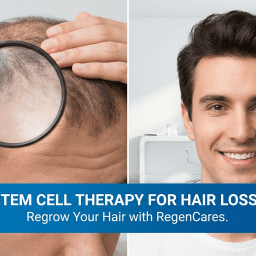
Stem cell therapy represents one of the most advanced approaches to hair regrowth treatment available today. It uses the body’s own regenerative cells to repair and reactivate hair follicles that have become weakened or dormant.
At Kansas Regencares, the approach is autologous, meaning stem cells are collected from the patient’s own body. This dramatically reduces the risk of rejection or adverse reactions. The extraction is performed using the state-of-the-art Spectra Optia Apheresis System, a technology that ensures precision and superior cell quality compared to standard equipment.
Once collected, the stem cells are processed and reintroduced into the scalp. They work by:
- Stimulating the formation of new follicular cells
- Increasing hair density and thickness over time
- Supporting the scalp’s natural tissue repair mechanisms
- Extending the anagen (growth) phase of the hair cycle
Stem cell hair restoration is a strong option for those experiencing progressive hair loss or who have not responded fully to PRP alone. It can also be combined with PRP for a more comprehensive approach to hair restoration.
Exosome Therapy for Hair Loss
Exosomes are tiny vesicles released by stem cells. They carry growth factors, proteins, and genetic signals that instruct other cells on how to behave and repair themselves.
Exosome therapy for hair loss works by delivering these powerful cellular signals directly to the scalp. The result is a targeted activation of dormant follicles, improved scalp circulation, and a more favorable environment for hair growth.
This treatment is ideal for patients who want the benefits of stem cell therapy at a cellular level without a more involved procedure. Exosomes act as biological messengers that essentially tell your scalp to regenerate.
At Kansas Regencares, exosome therapy is offered as part of the stem cell treatment protocol, giving patients access to a truly comprehensive, science-backed approach to hair restoration.
Combination Therapy: Why One Treatment May Not Be Enough
One of the most effective approaches at Kansas Regencares is combination therapy, where PRP, stem cells, and exosomes are used together to address hair loss from multiple angles.
Hair loss is rarely caused by a single factor. The most successful outcomes come from treatments that address the problem at the cellular level while also supporting overall scalp health and follicle activity.
A combination approach may involve:
- PRP to stimulate existing follicles and increase blood supply
- Stem cell therapy to regenerate damaged or weakened follicles
- Exosome therapy to enhance cellular communication and accelerate regrowth
This layered strategy is especially beneficial for patients with moderate to significant hair thinning, or for those who want the most comprehensive results possible from non-surgical treatment.
Is Hair Loss From Hormones Reversible?
This is one of the most common questions patients ask. The answer depends on the cause and how long the condition has been present.
Hormonal hair loss caused by thyroid imbalance, postpartum changes, or PCOS is often reversible once the hormonal issue is addressed. Hair typically regrows within six to twelve months.
Androgenetic alopecia is more complex. Because it involves the gradual miniaturization of follicles, the longer it goes untreated, the harder it becomes to reverse. Follicles that are still alive but weakened can often be reactivated with regenerative therapy. But follicles that have been dormant for too long may no longer respond.
This is why early treatment matters. The sooner you start, the better your chances of restoring meaningful hair growth.
Hair Loss Treatment for Men vs. Women
While the causes of hair loss overlap between men and women, the patterns and emotional experience can differ significantly.
Causes of hair loss in men are most commonly linked to androgenetic alopecia and DHT sensitivity. Men often see a receding hairline first, followed by thinning at the crown. Sudden hair loss causes in men can also include stress, illness, or nutritional deficiency.
Causes of hair loss in women are more varied. Hormonal fluctuations from pregnancy, menopause, thyroid issues, and PCOS play a bigger role. Women are also more likely to experience diffuse thinning across the entire scalp rather than defined bald spots. Hair loss in women over 40 often becomes more pronounced as estrogen levels drop.
At Kansas Regencares, both men and women receive individualized consultations and treatment plans. There is no one-size-fits-all approach. The goal is to find the right combination of regenerative therapies that matches each patient’s biology, hair loss pattern, and desired outcome.
Why Choose Kansas Regencares for Hair Restoration?
Kansas Regencares is a physician-led medical center in Overland Park, KS, built on the foundation of regenerative medicine. Every treatment is performed by board-certified physicians, not assistants or technicians. That distinction matters when it comes to precision, safety, and results.
For patients searching for a hair loss doctor in Overland Park or a hair loss clinic in Kansas City with real medical expertise behind every procedure, Kansas Regencares offers something rare: cutting-edge regenerative technology combined with genuine physician oversight.
Frequently Asked Questions About Hair Loss and Regenerative Treatment
How many PRP sessions will I need?
Most patients start with three to four sessions spaced four to six weeks apart. Maintenance sessions every six to twelve months can help sustain results.
Is PRP or stem cell therapy painful?
Discomfort is minimal. A topical numbing cream is typically applied before treatment. Most patients describe the procedure as tolerable, with mild soreness afterward that resolves quickly.
When will I see results?
Reduced shedding is often the first sign, usually within four to eight weeks. Visible improvements in density and thickness typically appear between three and six months.
Can these treatments be combined with other hair loss treatments?
Yes. PRP, stem cell therapy, and exosome therapy can be used alongside other approaches such as nutritional support or topical treatments for enhanced results.
Is treatment right for me if I have been losing hair for years?
It depends on the condition of your follicles. Follicles that are still present but weakened can often be reactivated. A consultation will give you a clearer picture of what is possible in your specific case.
Take the Next Step Toward Hair Restoration
Understanding what causes hair loss is the first step. The second is doing something about it.
Whether you are experiencing early-stage thinning, noticeable bald patches, or wondering why your hair has been falling out for months, Kansas Regencares has the expertise and the tools to help.
Our non-surgical approach uses your body’s own regenerative power to stimulate real, lasting hair growth. No harsh medications. No invasive surgery. Just science-backed treatment delivered by qualified physicians in a modern medical setting.
Ready to get started? Contact Kansas Regencares today to schedule your private consultation.
Hair restoration in Overland Park has never been more advanced. The right treatment is closer than you think.